

As we approach peak Cashew fruiting, cashew aggregators and exporters intensify efforts to buy and stockpile good quality RCN within a narrow harvest window. The difference between a good grade nut and a “reject” often comes down to what happens in the first 72 hours after the nut leaves the tree.
In this guide, we break down the technical essentials of harvesting, sun drying, and storing raw cashew nuts (RCN) to ensure maximum Kernel Outturn Ratio (KOR).
1. Identifying Peak Ripeness
The most reliable indicator is when the cashew fruit falls to the ground. Harvesting directly from the tree often results in immature, shriveled kernels. To ensure the kernel inside is mature, you may also look for these signs:
– Color Profile: The cashew apple should be vibrant (red or yellow), and the nut shell should be a hard, dull grey.
– The Firmness Test: A mature nut will be rock-hard. If you can dent the shell with a fingernail, it’s not ready.
2. Post-Harvest Handling: Nut Separation
Once gathered, the nut must be separated from the apple immediately. Leaving them attached for more than 24 hours leads to fermentation, which can seep into the nut and cause internal rot.
– The Technique: Hold the cashew apple and give the nut a firm twist.
– Cleaning (Optional): Use your thumb or a blunt tool to scrape off any remaining fruit pulp.
3. Sun-Drying and Moisture Control
This is the most critical stage of the cashew harvesting process. Raw cashew nuts arrive with roughly 25% moisture, but they must be brought down to 8%–10% for storage.
– The 3-Day Rule: Spread the nuts in a single layer on a clean concrete floor or heavy-duty tarps. They require 2 to 3 days of intense sun.
– Regular Turning: Use a wooden rake to turn the nuts every few hours. This ensures even drying and prevents “case hardening.”
– Moisture Verification: Use a moisture meter to test and confirm that the required moisture content has been achieved.
4. Professional Storage Standards
Proper drying is useless if the storage environment is poor. To maintain the quality of the nuts for export, follow the “ventilation rule”:
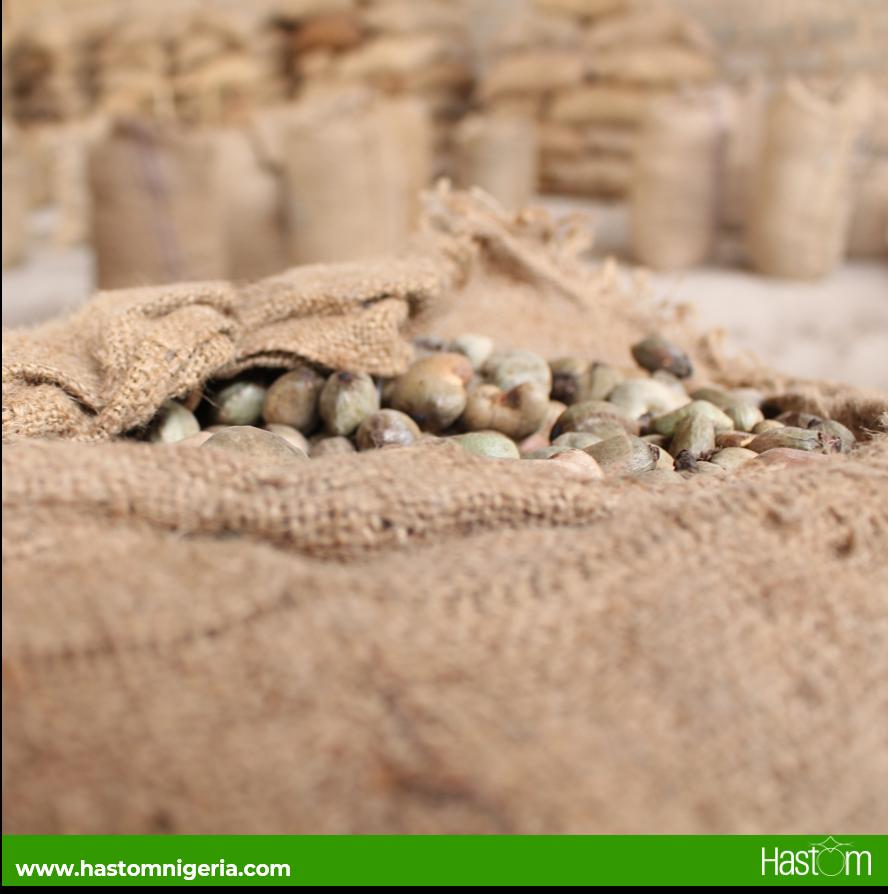
– Jute Bags Only: Use jute bags only, this helps to allow air circulation, unlike plastic bags that may trap excess moisture.
– The Pallet System: Always store jute bags on wooden pallets. Direct contact with concrete floors leads to “ground damp” and fungal growth.
– Stacking: Stack jute bags securely on pallets with adequate spacing to ensure airflow and prevent excessive compression.
At this stage, export quality is effectively determined. For raw cashew nuts to meet exportable standards, they must achieve a Kernel Outturn Ratio (KOR) of 48–52 lbs, a nut count of 160–180 nuts per kilogram, and a final moisture content of 8%–10%. A successful cashew harvest is therefore not driven by volume alone, but by the precision of the post-harvest process. When nuts are properly sun-dried to the required moisture range and stored under strict ventilation and handling standards, they can be preserved for up to 24–30 months while maintaining KOR. Hitting these thresholds protects kernel integrity, avoids grade downgrades or rejection, and positions the RCN to command higher prices in the global market.
A really good blog and me back again.
The article is well-researched and enjoyable. I love how consistently useful this website is.